






소식·공지
한반도와 이웃이 평화롭게 더불어 사는 세상을 만듭니다.
Wars Left Unexamined Lead to Repeated Mistakes: From Erbil to Hormuz
Wars Left Unexamined Lead to Repeated Mistakes: From Erbil to Hormuz
By Tae Kyung Kim
Professor, Sungkonghoe University (Policy Research Committee Member, Korean Sharing Movement)
Translated by Sam Lee (Coordinator, Korean Sharing Movement)
On April 2, 2003, barely two weeks after the United States invaded Iraq, South Korea’s National Assembly approved a motion to dispatch troops by a vote of 179 to 68, with 9 abstentions. The vote had been postponed twice amid public opposition, and the motion passed only after President Roh Moo-hyun delivered an address to the plenary session. Following the deployment of the Seohee and Jema Units, a contingent of 666 construction engineers and medical personnel, Washington requested an additional division-sized combat force on September 4, and on October 18 President Roh decided to dispatch additional troops. The National Assembly approved the additional deployment on February 13 of the following year by a vote of 155 to 50, with 7 abstentions. Only speeches in opposition were delivered before the vote; none were made in favor. By that point, the policy had been public for four months and its details finalized for two. The Assembly’s vote thus came close to an after-the-fact ratification of a decision already made.
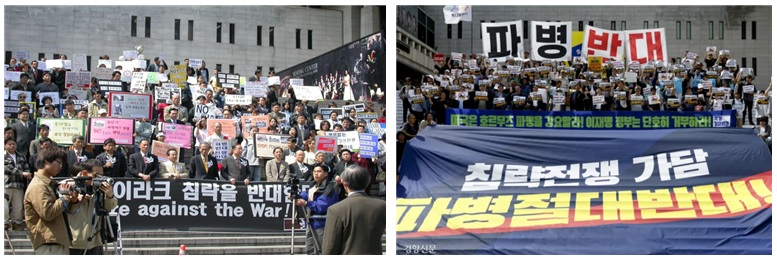
Although 23 years separate 2003 and 2026, South Korea’s civil society groups continue to voice their opposition to troop deployments at the same location. (Source: Left photo © KSM; Right photo © Kyunghyang Shinmun)
Twenty-two years later, in September 2026, the Lee Jae-myung administration raised the possibility of contributing a deployment to the Strait of Hormuz, in either a combat or a non-combat capacity. With the decision effectively already made, public opposition grew over concerns that the deployment would amount to intervening in the tensions around Hormuz. President Lee then drew a firm line, stating that there would be no deployment that involved Korea in, or intervened in, a war. At the same time, he left the door open to a contribution aimed at protecting the lives and property of Korean citizens.
As pressure from the Trump administration and public warnings from Iran continued, domestic concern grew over several issues: the obligation to uphold Article 5 of the Constitution, which renounces wars of aggression; the form and scope of any deployment and the National Assembly’s right to consent to it; and the possibility of being drawn into a war with even less justification than the Iraq War. Beyond these, the very absence of a process for building consensus on the overseas dispatch of armed forces, whether through National Assembly consent or through public deliberation, emerged as a problem in its own right. While the alliance and the national interest were being invoked, procedural rationality and democratic public deliberation were left by the wayside. This is closely tied to a lingering sense that, even after the Iraq deployment, Korean society has never properly reckoned with the deployment itself, with how the National Assembly and the public deliberated over it, or with what it ultimately achieved. Indeed, the National Assembly has never formally evaluated either the process or the outcomes of the deployment, and no post-hoc review has ever examined the errors made along the way or the questions that remain unresolved.
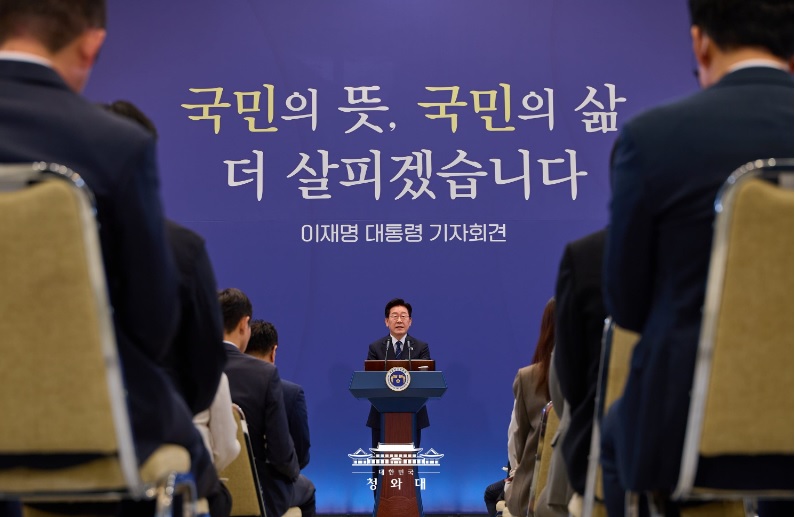
President Lee Jae-myung speaking at a press conference on September 18. He ruled out troop deployments involving participation in or intervention in a war, while leaving open the possibility of contributions aimed at protecting the lives and property of the public. (Source: © The Blue House)
Other countries that took part in the Iraq War, by contrast, undertook retrospective reviews. In the United States, the Senate Select Committee on Intelligence unanimously adopted a report in June 2004 documenting errors in prewar intelligence assessments and released it in July. In June 2008, it released a second-phase report, adopted by a vote of 10 to 5, concluding that the administration had repeatedly made claims unsupported by intelligence. The Netherlands’ Davids Committee concluded in 2010 that UN Security Council Resolution 1441 could not be interpreted as authorizing individual member states to use military force, and criticized the government for failing to fully inform parliament about the U.S. request for support. In the United Kingdom, the Chilcot Inquiry concluded in 2016, after seven years of investigation, that the UK had joined the invasion before peaceful options had been exhausted and that Prime Minister Tony Blair’s decision had been influenced by a desire to preserve the relationship with the United States. Denmark established a commission of inquiry in 2012, but abolished it following a change of government in 2015. An academic investigation commissioned in its place concluded in 2019 that the government had misrepresented intelligence to parliament.
The cases above share one thing in common: each left a national record of the grounds and process behind the decision. South Korea, at one point, sent the third-largest contingent, after the United States and the United Kingdom, and kept its troops in Iraq for five years and eight months, from April 2003 to December 2008. Yet neither the government nor the National Assembly has ever produced an independent evaluation examining errors in the decision-making process. The Constitutional Court, for its part, declined to rule on the merits on both occasions. In December 2003, it dismissed the constitutional complaint against the deployment of the Seohee and Jema Units on the grounds that the complainants were not themselves the personnel being deployed. In April 2004, it dismissed the complaint against the additional deployment on the grounds that the matter involved a highly political decision, and that whether the deployment was unconstitutional or constituted participation in a war of aggression was for the President and the National Assembly to judge. Without evaluation, there can be no lessons. The motions the government submitted to the National Assembly from 2003 onward, for the initial deployment, the additional deployment, and the extensions, all cited the development of the ROK–U.S. alliance as their first rationale. Yet no one has ever taken stock of what South Korea gained in return, and twenty-two years later, the same justification has returned in the same form.
Here, the concept of “national interest” warrants closer scrutiny. Article 5(1) of South Korea’s Constitution renounces wars of aggression, while Article 60(2) requires the consent of the National Assembly for the dispatch of armed forces abroad. These two provisions exist precisely to prevent the government from judging the national interest on its own. The proper order is not to suspend constitutional principles in the name of national interest, but to weigh the national interest within the bounds of those principles. In the case of Iraq, that order was inverted, and a similar inversion has occurred this time. The conflict in the Strait of Hormuz began without authorization from the UN Security Council. Even the U.S. Congress adopted resolutions in both the Senate and the House in June calling for the withdrawal of forces, and on September 15 the House of Representatives passed a third war powers resolution by a vote of 220 to 204. More than 60 percent of American voters regard the decision to go to war as a mistake. It falls to civil society to bring before public debate the question of whether contributing to such a war is compatible with Article 5 of the Constitution, and to the National Assembly to answer it. The press conference held on September 9 by 601 organizations opposing the deployment on the basis of Article 5 raised precisely this question.
There are also precedents for circumventing parliamentary oversight. In 2020, the government expanded the Cheonghae Unit’s area of operations to the Strait of Hormuz without National Assembly consent, citing a provision in the deployment motion that included “waters designated for operations to protect Korean nationals in emergencies.” A Ministry of National Defense directive also allows individual personnel to be deployed abroad by ministerial decision without parliamentary consent. Because the directive does not define what constitutes an “individual” deployment, it was identified as a potential loophole during the 2024 controversy over sending an observer team to Ukraine. This time, too, the prevailing view within the government initially favored relying on the wording of an existing consent motion.
Proposals have also been made for a general law governing overseas deployments. However, civil society has expressed reasonable skepticism that such legislation could serve more to provide a legal basis for deployments than to constrain them. In 2013, the Ministry of National Defense argued that legislation was needed because deployments other than peacekeeping operations (PKO) lacked a statutory basis, and mentioned considering a system of ex post parliamentary consent. A bill that passed the National Assembly’s National Defense Committee in 2014 would have expanded the categories of deployments to include multinational forces and training and education missions in non-conflict areas. Article 60(2) of the Constitution refers only to “the dispatch of armed forces to foreign states,” making no distinction between units and individuals, or between PKO and multinational forces. Once legislation divides deployments into categories, some categories may fall outside the scope of parliamentary consent. Any discussion of new legislation should therefore begin by asking whether it would expand or narrow the National Assembly’s constitutional right of consent.
The National Assembly and civil society each have a crucial role to play, both in the decision on Hormuz and in any future involvement in overseas conflicts. First, the National Assembly should begin its own evaluation of the Iraq deployment, even at this late stage. The US Senate Intelligence Committee published its report five years after the war began, and Britain’s Chilcot Inquiry published its report thirteen years after. Twenty-two years is a long delay, but it is better than no evaluation at all, and only such an evaluation can provide a benchmark for examining the motion to consent to the Hormuz deployment. Civil society, for its part, must shift from opposing decisions after they are made to fostering public deliberation before they are made. The Emergency People’s Action Against the Dispatch of Troops to Iraq, formed by 351 organizations in September 2003, could not prevent the deployment, but it helped limit the kind of units sent and shorten the length of their deployment. What sets the present moment apart is that civil society has mobilized before a final decision has been made. If the petition to the National Assembly, open until October 17, reaches the required number of signatures, the process should not stop at referral to the standing committee. It should lead to public hearings and broader public deliberation.
The lesson that South Korea in 2026 can draw from 2003 is that, for the sake of future decisions, the past must first be evaluated, both in society at large and in the National Assembly. The political community faces questions about Article 5 of the Constitution and the scope of the Assembly’s right of consent, and about how to weigh the national interest against the duty to preserve peace. It is through deliberating over these questions that democratic decisions will gain their legitimacy, one that cannot be reduced to policy rationality or efficiency.
| 번호 | 제목 | 작성자 | 작성일 | 추천 | 조회 |
| 공지사항 |
‘Free Care’ Gives Way to ‘Insurance’: Health Care Changes in the DPRK (Ju Hyun Um)
admin
|
2026.10.30
|
추천 0
|
조회 6964
|
admin | 2026.10.30 | 0 | 6964 |
| 공지사항 |
[KSM 평화칼럼] (7) ‘무상’이 사라진 자리에 ‘보험’이...북한의 보건의료 변화
admin
|
2026.10.26
|
추천 1
|
조회 8708
|
admin | 2026.10.26 | 1 | 8708 |
| 공지사항 |
[KSM 인턴 후기] '그럼에도' (글. 공세현)
admin
|
2026.10.19
|
추천 5
|
조회 9133
|
admin | 2026.10.19 | 5 | 9133 |
| 공지사항 |
몸으로 배우는 평화 - 서울교육대학교 평화축구 연수를 마치며
admin
|
2026.10.15
|
추천 0
|
조회 9596
|
admin | 2026.10.15 | 0 | 9596 |
| 공지사항 |
북의 변화상 살피고 남북협력 방향 모색하는 토론회 열려
admin
|
2026.10.15
|
추천 1
|
조회 10664
|
admin | 2026.10.15 | 1 | 10664 |
| 공지사항 |
2025 우리민족서로돕기운동 사업보고서 발간
관리자
|
2026.04.15
|
추천 0
|
조회 50841
|
관리자 | 2026.04.15 | 0 | 50841 |
| 203 |
평남 남포 대대리 돼지공장건설지원 - 준공이 눈앞에~ [등록일 : 2007-09-19]
관리자
|
2017.03.24
|
추천 0
|
조회 5404
|
관리자 | 2017.03.24 | 0 | 5404 |
| 202 |
제9차 평양 의학과학토론회 남측 대표단 28명 참석 [등록일 : 2007-09-19]
관리자
|
2017.03.24
|
추천 0
|
조회 5463
|
관리자 | 2017.03.24 | 0 | 5463 |
| 201 |
지원 물자를 북한 동포에게 전달하였습니다. [등록일 : 2007-09-04]
관리자
|
2017.03.24
|
추천 0
|
조회 5502
|
관리자 | 2017.03.24 | 0 | 5502 |
| 200 |
성금명단- 북한 수재피해, 여러분의 정성으로 구호물자 지원했습니다. [등록일 : 2007-08-30]
관리자
|
2017.03.24
|
추천 0
|
조회 5672
|
관리자 | 2017.03.24 | 0 | 5672 |
| 199 |
후원요청- 북한 수재피해, 여러분의 관심이 힘이 됩니다!! [등록일 : 2007-08-14]
관리자
|
2017.03.24
|
추천 0
|
조회 5426
|
관리자 | 2017.03.24 | 0 | 5426 |
| 198 |
긴급- 북한 수재피해 지원, 희망을 찾아주세요~ [등록일 : 2007-08-17]
관리자
|
2017.03.24
|
추천 0
|
조회 5271
|
관리자 | 2017.03.24 | 0 | 5271 |
| 197 |
긴급점검 라운드테이블 개최 안내 [등록일 : 2007-08-10]
관리자
|
2017.03.24
|
추천 0
|
조회 5496
|
관리자 | 2017.03.24 | 0 | 5496 |
| 196 |
적십자병원 구강병동 수술장 현대화 사업, 막바지 도달 [등록일 : 2007-07-24]
관리자
|
2017.03.24
|
추천 0
|
조회 5430
|
관리자 | 2017.03.24 | 0 | 5430 |
| 195 |
러시아 볼고그라드 소식 [등록일 : 2007-07-24]
관리자
|
2017.03.24
|
추천 0
|
조회 6306
|
관리자 | 2017.03.24 | 0 | 6306 |
| 194 |
러시아 볼고그라드 고려인 축제 참가단 모집! [등록일 : 2007-07-20]
관리자
|
2017.03.24
|
추천 0
|
조회 5526
|
관리자 | 2017.03.24 | 0 | 5526 |
| 193 |
제 1차 남북관계 쟁점진단 라운드테이블 안내 [등록일 : 2007-07-09]
관리자
|
2017.03.24
|
추천 0
|
조회 5408
|
관리자 | 2017.03.24 | 0 | 5408 |
| 192 |
''영통사 성지순례''를 위한 개성 방문 [등록일 : 2007-06-20]
관리자
|
2017.03.24
|
추천 0
|
조회 5424
|
관리자 | 2017.03.24 | 0 | 5424 |
| 191 |
개성 영통사 첫 성지순례 [등록일 : 2007-06-20]
관리자
|
2017.03.24
|
추천 0
|
조회 6073
|
관리자 | 2017.03.24 | 0 | 6073 |
| 190 |
''나무 한 그루가 평화와 통일의 씨앗될 것'' [등록일 : 2007-04-03]
관리자
|
2017.03.24
|
추천 0
|
조회 5878
|
관리자 | 2017.03.24 | 0 | 5878 |
| 189 |
부설 법률지원센터 “우리동포‘ 설립 [등록일 : 2007-03-29]
관리자
|
2017.03.24
|
추천 0
|
조회 5564
|
관리자 | 2017.03.24 | 0 | 5564 |
| 188 |
제 30회 평화나눔센터 정책포럼 초대 [등록일 : 2007-03-13]
관리자
|
2017.03.24
|
추천 0
|
조회 5789
|
관리자 | 2017.03.24 | 0 | 5789 |
| 187 |
북으로 보낼 전염병 치료약 1차 출항식을 가졌습니다! [등록일 : 2007-02-23]
관리자
|
2017.03.24
|
추천 0
|
조회 5338
|
관리자 | 2017.03.24 | 0 | 5338 |
| 186 |
나눔소식- 백두산야생더덕 판매액의 5% 후원 [등록일 : 2007-02-15]
관리자
|
2017.03.24
|
추천 0
|
조회 5594
|
관리자 | 2017.03.24 | 0 | 5594 |
| 185 |
북한의 전염병 확산, 여러분의 도움이 필요합니다! [등록일 : 2007-01-30]
관리자
|
2017.03.24
|
추천 0
|
조회 5440
|
관리자 | 2017.03.24 | 0 | 5440 |
| 184 |
조선적십자종합병원- 신경·호흡기병동 준공식 개최 [등록일 : 2006-12-27]
관리자
|
2017.03.24
|
추천 0
|
조회 5542
|
관리자 | 2017.03.24 | 0 | 5542 |