






News
Selfless sharing – not only of resources but also of pain and sorrow, yearning and hope – is the first step on the road to reconciliation
Interview with Lee Cheol-Joo Producer of KSM hosted Unification New Year’s concert
작성자
관리자
작성일
2020-04-20 17:30
조회
1180
“I want to host south-north collaborative New Year’s concerts annually”
“North Korean music has preserved elements of our unique shared tradition.”
“Since encountering North Korean arts I dream of inter-Korean cultural exchange. For the time being that is as the producer of the Unification New Year’s Concert.”
“We must promote exchange through increasing inter-Korean contact.”
The Korean Sharing Movement and News 1 co-hosted the ‘2020 Unification (Tong-il) New Year’s ‘Hana Concert’’ on February 5th in Seoul’s Lotte Concert Hall.
Lee Cheol-Joo the Secretary General of Yeyeonjae who plans and produces the Unification New Year’s concert is an expert of North Korean arts who is busy making various attempts to promote inter-Korean cultural exchange. Below is an interview with Cheol-Joo based on a Q & A session at the Korean Sharing Movement’s office.
* Yeyeonjae was founded at the start of 2019 as a non-profit organization with the goal of conducting cultural exchange involving South, North and overseas Koreans.
The views expressed here are those of the interviewee and do not necessarily represent or reflect the views of KSM

Lee Cheol-Joo (Picture: Kim Song Hon)
-You have hosted the Unification New Year’s Concert for three years now. Can you tell us how you feel about the concert?“When we first planned the concert we envisioned and hoped for a joint south-north performance. However, due to the deteriorating political situation we have only been able to host performances involving musicians from the south. To be honest, I didn’t know that it would go on for three years. I had doubts about whether people in South Korea would respond positively to North Korean music. However, as each year passes the reception from the audience gets better and better, so much so that from next year at the 4th concert we will have performances in both Seoul and Suwon. This is something I am very pleased about.”
– What was it that led you to begin this endeavor of bringing North Korean music to South Korean society?
“In 1999 I participated in the planning for the Pyongyang International Music Festival which provided me the opportunity to experience the north’s music. It was a huge cultural shock for me. This combination of capital from the south and the human resources and contents from the north could be the key to Korean culture (Hallyu) going global. It really got me thinking. Does South Korea have performance art that we can show off on the world stage? Traditional Korean music has undergone a process of fusion for modern audiences, and there have been idol groups such as BTS that may be known all over the world, but this genre is somewhat different. I’m talking about something like ‘The Phantom of the Opera’ where the piece becomes a proper noun in of itself for future generations to enjoy. As I was looking through some North Korean artistic content I came across a film called Meet in Pyongyang. Of all the movies that I have seen this film presents the music and dance of North Korea most accurately. Another film that I found interesting to watch was Comrade Kim goes Flying about a worker who dreams of becoming a performer. That is how I got started on this track.
– What would you say overall about the distinct features or flow of North Korean art and music?
“When people talk about South and North Korean art they usually start with the similarities. However, the differences are actually more prevalent. With regards to those similarities I’m not sure if they remain in matters of form, but in terms of content I think that they just don’t exist anymore. In this arts sphere I think the only remaining link between south and north is our tradition, in the north they are making efforts to preserve our traditions in music. In North Korea they have made efforts to produce and disseminate refined traditional instruments. For example in the south the traditional haegum (bowed string instrument) has the bow on the inside of the strings whereas in the north, like a western cello, it is played on the outside. This change was initiated so as to be able to play a Western musical scale. Even if you say that is ‘Western’, the north expropriated it to globalize their socialist art. The refinement of musical instruments and these instruments’ combination with orchestral music represents North Korea’s diverse attempts to change their own musical identity.
– I’m wondering about what kind of process you need to undertake to be able to bring North Korean works into the south, if you want to perform these pieces there must be a lot of processes to get the necessary permission.
“There are still a lot of regulations relating to existing legislation around inter-Korean exchange. First of all you need to get permission from the Ministry of Unification and that requires taking care of numerous things. In cultural exchange there are certain contents which remain out of bounds. Contents regarding North Korean leaders or the Korean War can cuase a lot of problems. In addition you need to prove that a North Korean piece has sufficient artistic merit to warrant being played in South Korea. The North has an arts group called The Pibada Opera Troupe (Sea of Blood Opera Company) which performs to a really high standard but the name in itself usually provokes hostility for us. So you can see that it would not be easy for us to host a North Korean performance group for performances in South Korea regardless of their artistic ability.”
-As a producer of events, when you present something unfamiliar to South Koreans such as music from the north, what points do you think you need to emphasize?
“Firstly, for any type of performance you need a good venue. That is why we always take pains to ensure that we can hire somewhere like the Lotte Concert Hall. Secondly, you need to bring an orchestra that can perform to an outstanding level. Most importantly you need to source a great conductor. Of course there are many fantastic conductors in South Korea, but most of them learnt conducting techniques in the West and so the distinct flavor of the north’s music isn’t quite conveyed. In light of that you need to find someone who has studied in North Korea, but that of course is no easy task. Finally, for a successful concert you can’t make it too novel for the audience. If you just perform North Korean pieces then the concert will be too full of unknown music and so it is good to find a balance with some world renowned Western pieces.”
-How does a southern orchestra prepare to perform the unfamiliar northern music?
“First and foremost the arrangement is very important. A good arrangement allows the score to be conveyed to each member of the orchestra. Each member of the orchestra practices alone before coming together for group rehearsals. This year we had about 4 group rehearsals, which might be fewer that you might have imagined but when you consider the caliber of our orchestra it isn’t a small number.”
-What do you think is the biggest difficulty in conducting inter-Korean cultural exchange? I assume in your varied experience you have come across different types of problems.
-“I’d have to say that the biggest obstacle would be peoples’ prejudices. Of course for policy makers some of that is unavoidable. But most people don’t know about North Korea arts. In general they equate North Korean arts with human rights infringements. Saying that a child being made to practice for a long time is a human rights problem or that anything to do with North Korean arts must be all propaganda. If you understand the North Korean school system then you can take a step back from the human rights discourse, if you divest yourself from preconceived notions you can appreciate North Korean art.
The other main obstacle is copyright. It’s a systematic problem, the copyright for most international classical music have expired so you can have performances without enduring large costs. Furthermore, North Koreans do not pay for North Korean music, it is free. However, to perform North Korean music in South Korea you need to pay a lot of money to the people holding the copyright here in South Korea. Of course, North Korean music needs to be protected through copyright, but when there are civil society groups or unification groups that want to introduce North Korean music for the common good through a free concert or for the expansion of inter-Korean cultural exchange, it would be good if these license fees could be waived.”
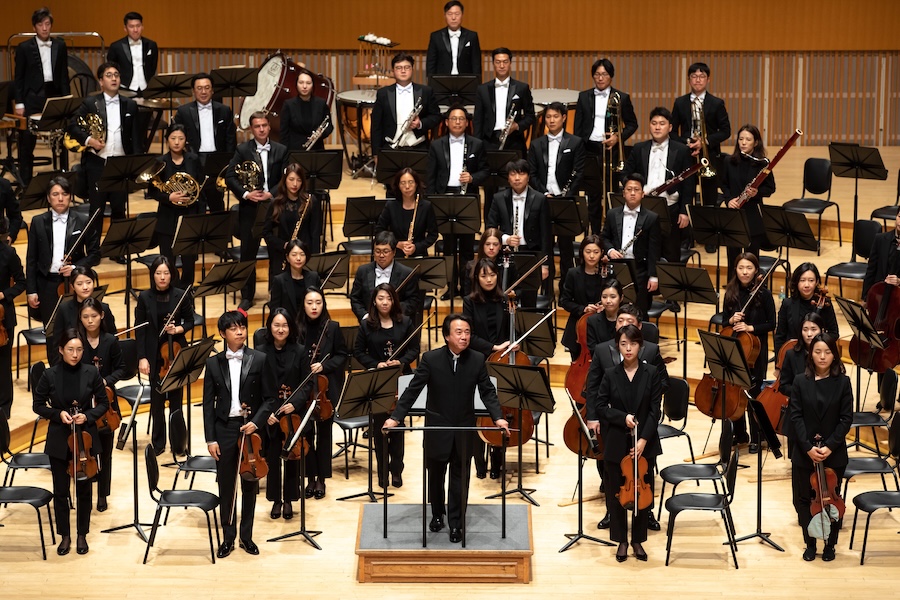
The Gyeonggi Philharmonic Orchestra at this year’s Unification New Year’s Concert
-What things are most needed for these inter-Korean exchanges through arts projects to be expanded?“At the government level there needs to be some organization that can take charge of cultural exchange and reorganize the related systems and laws. Most people don’t know about the north’s musical repertoire and how people in the north enjoy music. It would also be good if projects in the cultural exchange field could have access to the Inter-Korean Cooperation Fund. Traditional masked dance exchange would also be good, as would inviting famous orchestras from around the world to perform in North Korea.
The most important thing is to continue varied types of exchange. Even before people from the south and north can meet directly, through the sharing and exchange of culture and art we can and must increase our understanding of one another. We have to go through this stage first for south and north to be able to become closer to one another. Furthermore music can move people in a way that transcends rationality and politics which helps make it the most suitable medium for inter-Korean exchange. You also need to see past the ideology and the politics to find the creative essence of North Korean art. Art is basically a common language which can’t help but be understood.”
– As a producer is there any goals that you would like to achieve in the not too distant future?
“In the North near the beginning of each year they have a new year’s concert. Once this concert is finished if they came south and gave a joint performance I think that would be very moving so I would love to produce such a concert. After that our orchestra would go north and perform together up there. With regards to the Unification New Year’s Concert I think the ending piece of music is really important. I would really like to plan an ending piece created by both south and north. In the north they usually make music as a collective. If we added in a composer from the south the result would be a collaborative piece of music.”
-Finally, can you tell us the preeminent reason why you want to perform North Korean music in South Korea?
-“Basically it is to help break down prejudice and promote the restoration of a combined Korean identity. Another factor would be music’s ability to usher in peace. Music and peace have naturally interconnected on numerous occasions. During the siege of Sarajevo the cellist Vedran Smailović came out despite the snipers and performed for twenty-two consecutive days for the people holed up in fear in surrounding buildings. This is the power of music. After the opening of China Pavarotti was one of the first people to go there and his performance was tremendously well received. There are various different examples which can highlight how music has paved the way towards peace. Music can open the door for peace between south and north on the Korean peninsula. Moving forward I also have a dream for the Unification New Year’s Concert to develop into a world renowned concert for peace and togetherness. In that way hopefully in the future we will be able to reflect on how it has helped to establish peace.
Interviewer’s note: Listening to Lee Cheol-Joo speak from the heart I came to sympathize with the idea that music and art can become a cornerstone of the peace process. The most lasting impression came with the idea that because music is a language which can transcend ideology inter-Korean exchange through music can provide a little piece of peace to everyone living on the Korean peninsula. Rather than remaining mired in discussions on national security wouldn’t it be better to increase inter-Korean contact and thereby provide more opportunities to develop understanding that could then lead to coexistence and peace. In the coming ten, twenty years, or until peace plants its roots on the Korean peninsula I hope that the Unification New Year’s Concert can become such a point of contact for people living in both the south and the north.
(Jin Youngbin KSM Policy Team Coordinator)